The IRS Handed Credit Unions an Auto Loan Compliance Nightmare
By Jeff Bassill — September 19, 2026
The deduction belongs to your members. The reporting burden belongs to you.
On September 8, Treasury and the IRS finalized the regulations implementing the new car loan interest deduction. If you handle compliance or finance at a small credit union, this rule deserves your attention even though the deduction itself belongs to your members. The reporting obligation belongs to you.
Beginning with interest received in 2026, a lender that receives $600 or more in qualifying interest on a personal vehicle loan must file Form 1098-VLI and furnish a copy to the borrower. The regulation is final. The form and instructions are still marked draft. And the number of loans potentially affected is much larger than the 2026 effective date makes it sound.
The back book starts in 2025
Qualifying indebtedness reaches back to January 1, 2025. So the loans you must evaluate are not limited to this year's originations. They include every vehicle loan on your books incurred since January 2025 and still generating interest in 2026. As of publication, that is roughly twenty months of originations.
Each loan is a potential Specified Passenger Vehicle Loan, or SPVL, and each one must pass through the determination process before you know whether a 1098-VLI is required.
Notice 2025-57 gave lenders transition relief for 2025. A general statement showing total interest received from the borrower could satisfy the reporting obligation without a loan-level determination. That relief ended with 2025. For 2026, you need a specific answer, loan by loan and borrower by borrower, for a population that already includes everything booked since January 2025.
The rule asks for data many lenders do not track
Treasury's final rule confirms the operational problem. Commenters, including credit unions, explained that lenders do not currently track all the information needed to classify these loans. The missing data can include original use, vehicle assembly location, and the portion of the balance attributable to negative equity.
Treasury's response was straightforward: lenders already have a general recordkeeping obligation under the tax code. That obligation now extends to this data, whether or not the lender's systems were designed to capture it.
Negative equity is where the work multiplies
The rule is clear on one point: negative trade-in debt does not qualify. The harder question is what should be credited against that amount before the remaining negative equity is calculated.
The regulation offsets negative equity by any down payment or other consideration supplied by the taxpayer. A reasonable argument exists that a manufacturer rebate counts when it is assigned toward the purchase price, consistent with how some states treat rebates and down payments in retail-installment disclosures. But the final regulatory text does not identify rebates specifically, and a rebate originates with the manufacturer rather than with the borrower. That makes this an interpretation, not a stated rule, and it can be decided either way on reasonable grounds.
The practical answer does not depend on which way you decide.
Capture negative equity, the cash down payment, and any rebate as three separate stored values and compute the qualifying ratio both ways. Then a change in position reverses by recalculation rather than by reopening files. If your tax advisor disagrees with you in December, that should cost an afternoon of computing, not a second pass through the deal jackets.
Any negative equity remaining after the offset must be separated, with interest allocated pro rata between the qualifying and nonqualifying portions. No alternative allocation method is permitted. Apply that process across every retail and indirect auto loan originated since January 2025 that you still hold, and the burden becomes obvious. This is not merely a missing field. It is a review process built around information that may exist only in the dealer file.
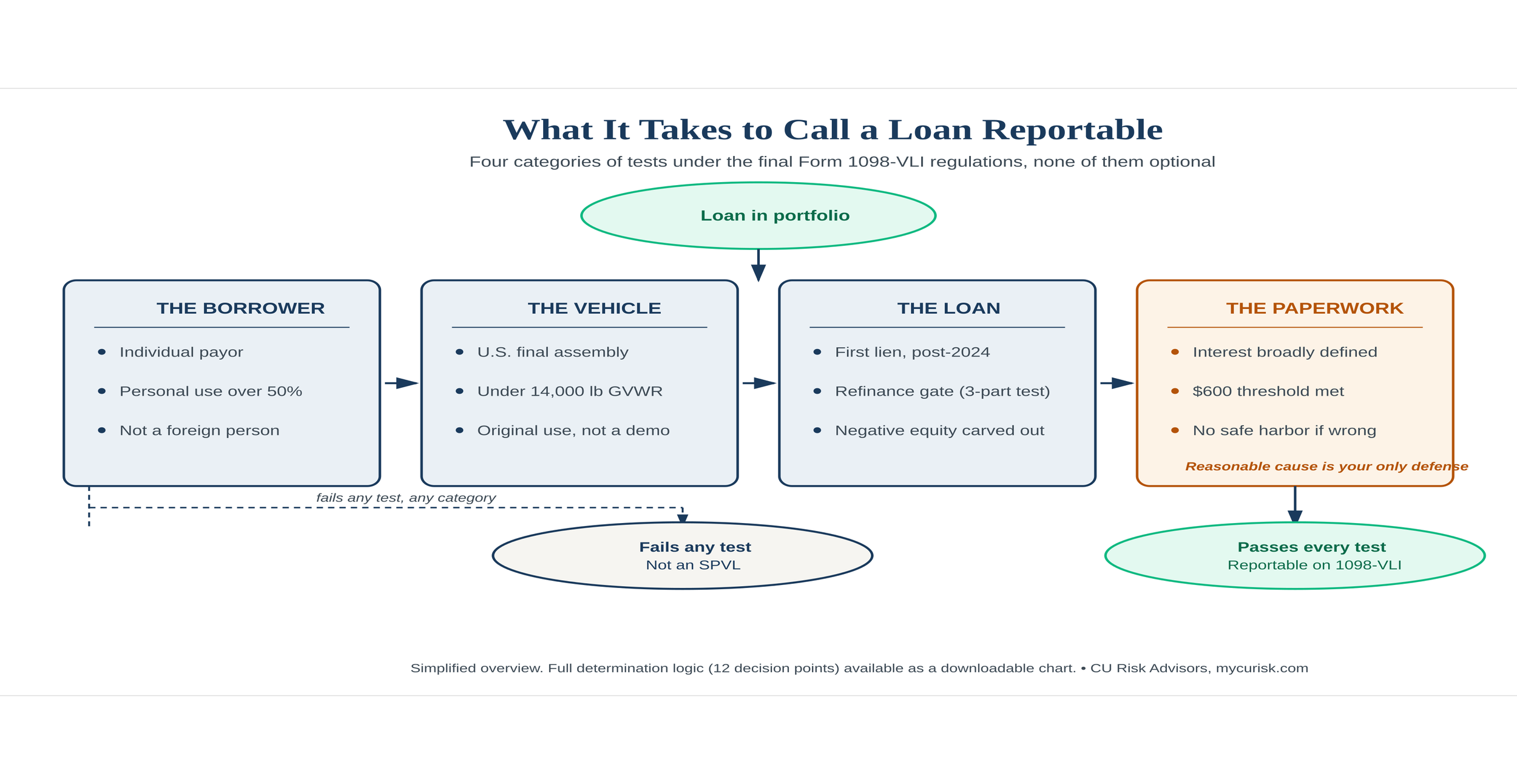
The full determination runs twelve decision points deep. It includes a pro rata allocation step and a refinance test that passes only when all three conditions are met:
1. The prior loan was itself an SPVL.
2. The same person remains the obligor.
3. The new loan amount does not exceed the prior loan's payoff balance.
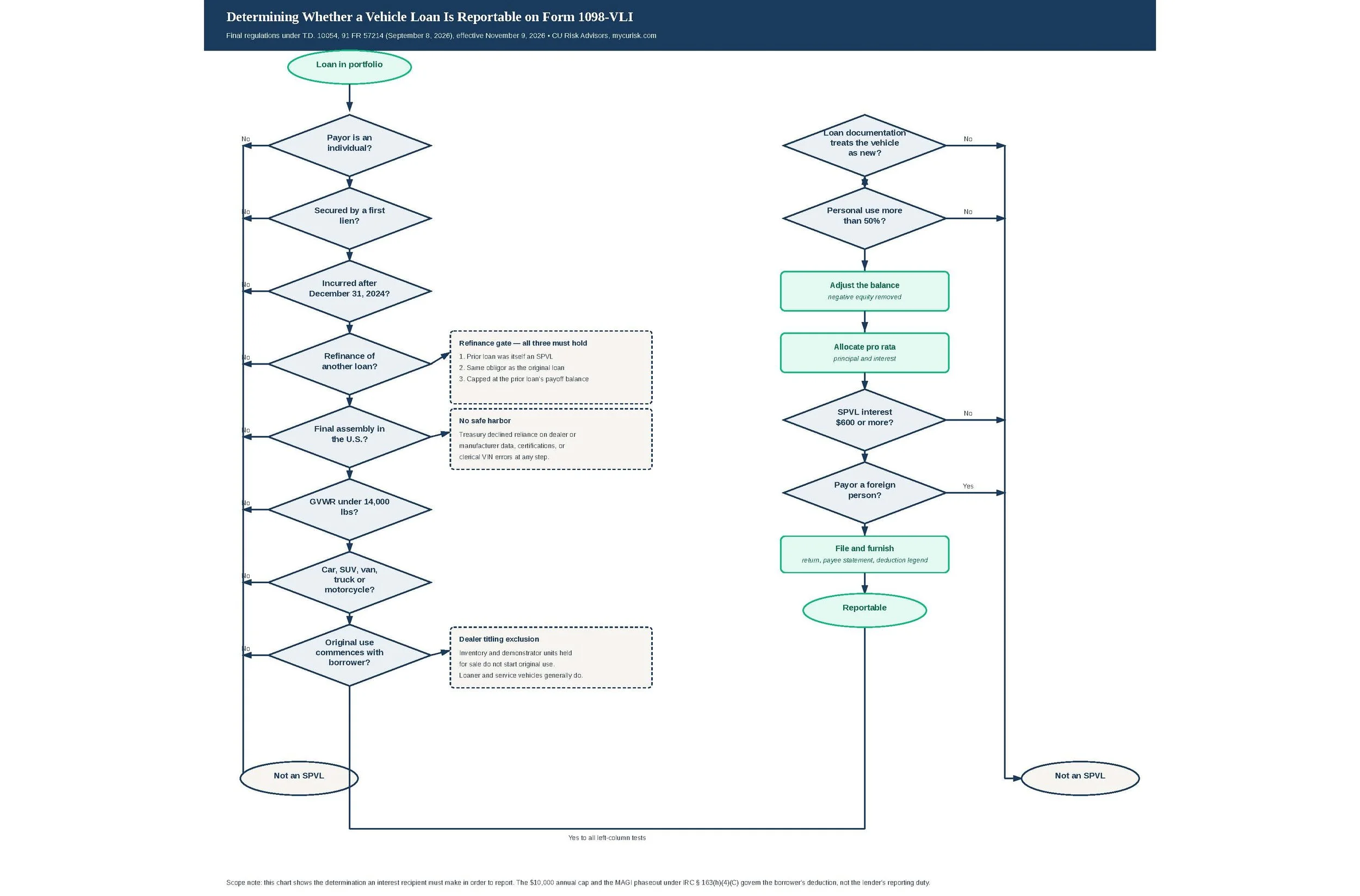
That test is not limited to loans your credit union refinanced. The lineage analysis appears to follow the loan, so an acquired or participated loan would carry the same three conditions. That is a reasonable inference rather than confirmed regulatory text, so treat it as an open question for your own tax advisor. I have also posted a full determination chart for anyone who needs to walk an individual loan through the process: download the full 1098-VLI determination chart. https://mycurisk.com/1098
Ordinary reliance is not a safe harbor
This is the point that deserves immediate attention: the rule provides no safe harbor. A credit union may generally rely on its own loan documentation when making these determinations, provided nothing suggests the documentation is incorrect. That is useful, but it is not protection against incomplete or mistaken records. It simply means you do not have to independently re-verify every fact before acting on the file.
Lenders asked for more. They requested permission to rely on dealer certifications for new-vehicle status, borrower certifications for refinance eligibility, or broad reporting of interest on all vehicle loans so the IRS could determine deductibility. Treasury rejected those requests, including relief for clerical VIN errors.
Treasury's position is that lenders had roughly eighteen months from enactment to build the required systems, so no additional transition period or phase-in is warranted. Whether core and LOS vendors delivered usable tools during that period is not part of Treasury's analysis.
The remaining backstop is reasonable cause under IRC 6724(a). But reasonable cause is a penalty-abatement argument made after an incorrect filing. It is not a compliance framework. A return that requires multiple judgment calls across a twenty-month back book should not be built around the hope that reasonable cause will rescue the errors later.
For a small credit union with one compliance officer and systems never designed to track VIN plant codes or refinance lineage, this is a real liability, not a hypothetical one. Penalties under IRC 6721 and 6722 apply per return and vary based on how quickly errors are corrected. A systemic classification mistake therefore does not create one error. It can create an error for every affected loan in that category for the entire reporting year.
What to do now
Start by finding out what you actually have.
• Audit your data fields. Sample loans originated since January 2025. Determine whether the LOS and core store negative trade equity and down payments as separate values or merely net them into the amount financed. Check refinance lineage, including acquired and participated loans, along with vehicle assembly location and GVWR.
• Scope the manual review. If negative equity was never captured separately, the answer will not come from a database query. Someone may need to open imaged deal jackets and extract the figures loan by loan. Identify that now. The staffing needs for a document-review project are very different from those of a data project.
• Demand vendor timelines. Do not assume your core or LOS provider is building 1098-VLI functionality because the rule is final. Obtain written delivery dates so you know whether you need a temporary workaround or an ongoing manual process.
• Update reporting parameters. Add 1098-VLI as a distinct return type in your 1098-series procedures and vendor files. Confirm that your process generates one statement per loan for the payor of record, not one for every co-borrower.
• Establish a formal tax position. Document how the credit union will handle ambiguous calculations, including whether manufacturer rebates offset negative equity. Obtain tax-advisor approval before applying the position across the portfolio.
• Fix new originations now. Require structured, queryable fields for negative equity, down payments, vehicle assembly information, and refinance lineage in new retail and indirect auto loans.
Reduce the review population before opening files
OOrder the screening by cost, not by the order the tests appear in the regulation. Two screens cost nothing at all, require no policy decision from anybody, and should run before everything else.
Screen on interest received first. The $600 threshold applies to qualifying interest, which is interest received multiplied by the loan's qualifying ratio. That ratio can never exceed one, so allocation only ever reduces the figure. A loan whose interest for the year cannot reach $600 cannot produce $600 of qualifying interest, and it is out before any eligibility work at all. Before the year closes this sizes the project rather than finally excluding anything, so run it again on final figures in January. One carve-out: a reimbursement of prior year overpaid interest of $600 or more is an independent filing trigger, so whatever logic retires your below-threshold loans has to test both conditions.
Then decode your VINs in bulk. This resolves assembly location, vehicle type, and GVWR across the whole portfolio at once, at no cost, against the NHTSA vPIC catalog. Run it early rather than on the loans that remain, because the loans it disqualifies never reach the tests that cost something. Expect three outcomes rather than two: disqualified, clear, and needs manual review. Only the first retires a loan.
Three more screens are cheap but not free of judgment.
• High-mileage vehicles. A vehicle with substantial mileage at origination likely did not begin its original use with your borrower, and mileage is a field many lenders already capture.
• Purchases from used-car lots. Dealer type can provide a quick exclusion when the vehicle came from an independent used-car dealer and the paperwork captures that fact.
• Older model years. Vehicle age can serve as a practical screening proxy for the original-use limitation.
Each of those three needs a threshold, and the threshold is yours rather than Treasury's. Mileage is evidence bearing on original use, not the test itself, and nothing in the rule names a number. Count the loans each screen would touch before you set the cutoff, document what you chose as a presumption, and make it rebuttable in both directions.
My CU Risk VIN tool at mycurisk.com/vin runs the vehicle-side screen for you. Paste a list or load a CSV and it returns your original columns with the screen appended, so the result joins to your loan numbers without manual matching. NHTSA accepts fifty VINs per request, so longer lists are batched automatically and there is no limit on how many you can run. It decodes from your own browser directly against NHTSA, so nothing you enter is sent to CU Risk Advisors.
After those screens, the remaining population should be concentrated in three areas: refinances with uncertain lineage, loans with net negative equity after the permitted offset, and loans near the $600 reporting threshold. That is the population that deserves the expensive review work.
Use the right source for the remaining questions
• Vehicle history report. Use Carfax or a comparable source to evaluate original use, mileage, and prior registration or lease events.
• Credit bureau trade lines. The credit report already in the loan file from origination usually shows the prior loan's open date, lienholder, and balance, which is what the lineage test needs. Work from that report rather than ordering a new pull, because a new inquiry for a tax reporting purpose raises a permissible purpose question you do not need to open. And note that a prior loan opened before January 1, 2025 cannot itself have been an SPVL, so the refinance fails the first condition outright. That is a determination you can make from a document you already have, not a gap.
• State title records. Use them to confirm first-lien status and initial titling date when those facts are not clear from the loan file.
The filing calendar is closer than it looks
The borrower statement is due January 31. Paper returns are due to the IRS by February 28, while electronic returns are due March 31. The electronic filing threshold is ten returns aggregated across all information return types, so nearly every credit union exceeds it on existing 1099 and 1098 volume alone and the March date is the one that applies. The later IRS deadline provides some runway, but the member-facing deadline still arrives first.
One sequencing point is worth more than it looks. Allocate first, then test the $600 threshold against the allocated figure. Test gross interest first and you will file returns that should never have gone out, and nothing downstream will catch it.
The larger problem
The 1098-VLI obligation is final, the form is not, and the review population reaches back twenty months rather than eight. The blanket statement permitted for 2025 no longer works. Credit unions told Treasury they do not have all of this data. Treasury answered that the recordkeeping obligation applies anyway. With no safe harbor, the best protection is a documented and defensible process built before filing season begins.
The problem is not that Treasury set out to make the rule complicated. Congress created a member-level tax benefit and assigned the recordkeeping to whichever institution holds the loan, without regard to whether that institution has the staff or systems to perform the analysis efficiently. A large bank can hand the work to an existing tax-reporting team. A small credit union may be asking one compliance officer to add a twenty-month back-book review to everything already on the desk.
That is why this rule matters beyond Form 1098-VLI. Information-reporting requirements are often written for institutions with dedicated staff, mature systems, and ready access to specialized counsel. Small institutions must either build capacity they cannot easily afford or accept a level of compliance risk their larger competitors can spread across an entire department.
If your trade association is collecting comments about 1098-VLI or information-reporting burdens generally, ask it to support an asset-based reporting threshold or a longer phase-in for smaller institutions. Either approach would preserve the reporting objective while giving small credit unions a more realistic path to compliance. The right time to make that case is before institutions are forced to build permanent manual workarounds around a form that is not yet final.
Since publishing this, I have put the whole determination process into a free four-part toolkit covering identification, gap inventory and vendor requests, policy decisions and evidence standards, and the calculation and filing cycle. No registration and no license terms. Download the Vehicle Loan Interest Reporting Toolkit.