

Form 1098-VLI Is Final, and Most of the Hard Parts Stayed
By Jeff Bassill | October 23, 2026 | jeff@mycurisk.com
In September I wrote that the IRS had handed credit unions an auto loan compliance nightmare, and that the form and instructions were still in draft, so the mechanics could change. They're final now. The IRS posted the Instructions for Form 1098-VLI, Rev. December 2026, on September 30, for calendar year 2026 and later years until a new revision replaces them. The regulations under T.D. 10054, 91 FR 57214, take effect November 9, 2026.
The final release changed one reported figure. It closed most of the mechanical questions, nearly all of them in the direction of more work for the lender. The hard interpretive questions are right where they were.
What the final release settled
The determination belongs to the lender. Treasury declined to let lenders report broadly and leave qualification to the borrower, so every loan needs its own answer. Lenders also have to do adequate diligence on refinanced debt, even when the original contract can't be found.
The safe harbor I said wasn't there still isn't. Treasury declined reliance on dealer data and on dealer certifications of new-vehicle status, and gave no relief for clerical VIN errors. A documented, approved process that supports reasonable cause under IRC 6724(a) is still the only defense, and you make that argument after a return is already wrong.
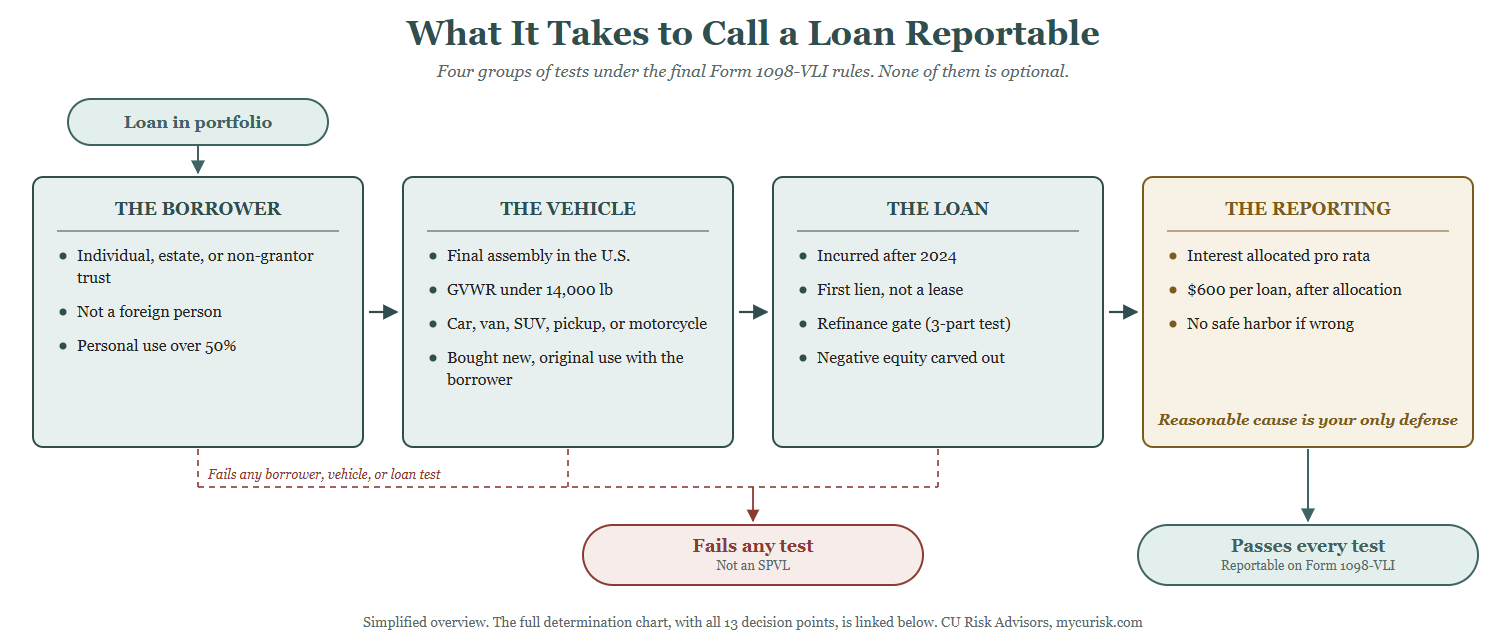
The arithmetic is settled. Indebtedness that mixes qualifying and nonqualifying items must be allocated pro rata. Treasury declined alternative methods, and there is no materiality or de minimis allowance, so a few hundred dollars of rolled-in negative equity still gets carved out. Negative equity financed from a trade-in is not qualifying debt. The $600 threshold applies to each loan separately and is never combined across a member's loans. A reimbursement of $600 or more of prior-year overpaid interest is its own filing trigger.
One piece of help came through. The preamble (Part III.B.2) lets a lender rely on the retail installment contract to show personal use, absent conflicting information. That answers the personal-use test from a document already in the file.
The calendar is settled too. Borrower statements are due January 31, paper returns February 28, and electronic returns March 31. The e-file threshold is 10 returns aggregated across all return types (T.D. 9972), so nearly every credit union files electronically. In 2027, January 31 and February 28 both fall on a Sunday, so the next business day applies. Plan to January 31 anyway, because a weekend leaves no room for a correction.
What changed
Box 4 is the one that moves a number. The final instructions define it as outstanding principal as of January 1. For a loan originated or acquired during the year, it is principal as of the origination or acquisition date. In the first filing year, that second rule covers every loan a credit union made in 2026. Anyone who read Box 4 differently from the draft needs to recheck how their system fills it, and that includes me, since my toolkit 1.1 said principal as of the reporting date. Ask your core or 1098 vendor which date the system uses, and get the answer in writing.
Two other box rules arrived with the final instructions. Box 1 includes a prior overpayment credited against the current year's payments. Box 6, the original-use attestation, is also checked when the payer of record became an obligor on a prior obligor's death.
One more item comes from the final regulation itself, and it lands on the same January calendar. Treas. Reg. 1.163-16(c)(2)(i) treats points, capitalized interest, and late, default, and similar charges as interest where they are interest for federal income tax purposes. Box 1 is interest received, so find out what your core counts as interest received and settle it before January.
What is still open
The rebate question I raised in September is still open. Nothing in the final release says whether a manufacturer rebate offsets negative equity the way a cash down payment does. That stays a position your credit union takes with its tax advisor and applies the same way across the portfolio.
The final instructions also left these unanswered:
• whether reimbursements on separate loans to one member combine toward the $600 reimbursement trigger
• whether a refund of 2025 interest is reportable, given that 2025 ran under the general interest statement relief
• which date marks incurrence, the contract date or the funding date, and whether dealer-assigned indirect paper counts as originated or acquired
The last one decides whether a contract signed in late December 2024 and funded in January 2025 is in the population, and it drives Boxes 3a and 3b on every indirect loan. Treat each of these as unsettled in both directions. Write down your position, the reasoning, your advisor's name, and the date, and get it approved before anyone starts reviewing files. With no safe harbor, that dated record is what you have.
The larger point from September hasn't changed either. I argued for an asset-based reporting threshold or a longer phase-in for smaller institutions, and the final instructions provide neither. A small credit union still faces the full back book since January 2025, with member statements due at the start of February. If your league or trade association is collecting feedback on information-return burden, send them the hours this project is taking you. Real hours from a real credit union carry more weight than a general complaint.
The free toolkit, updated
If your credit union worked from version 1.1 of the free toolkit I published in September, it was written against the draft form. Version 1.2 is checked against the final instructions and comes in two forms. The short version is for the CEO and the board, or whoever has to get the project moving. It has two one-page documents (Ten Steps to Get Started, and a form listing the 17 decisions the rule leaves to the credit union, each labeled OPEN or RISK) plus a companion that explains each decision. None of it tells you what to decide. The full toolkit, about 58 pages in Word, is for the person doing the work: the data pull, the vendor inquiry, the evidence standards, the file review, and the January calculation and filing.
If you used 1.1, check two things. The first is Box 4, as above. The second is the VIN screen. If you ran the earlier tool and excluded loans because a vehicle came back as a bus, low speed vehicle, incomplete vehicle, or motorhome, run those VINs again. Version 1.2 of the tool sends those to manual review instead of failing them, since large passenger vans are often typed as buses. It also checks each VIN's check digit and stamps the tool version and screening date on every row.
All of it is free at mycurisk.com/1098. Version 1.1 stays there as an archive for anyone who needs to show what they relied on.
The views expressed here are my own and do not represent the official position of Kings Federal Credit Union. This post and the materials it links to are general information, not legal, tax, accounting, or compliance advice. Get your own legal and tax advice, and verify citations and deadlines against the published guidance before you file.
